
Appleton Directory Collections by Year
Appleton city directory evidence is split among printed shelves, catalog records, and free scans. No official source confirms that every annual volume survives. These verified anchors are known points, not a continuous run. The Appleton Public Library genealogy desk can check the Jabas Appleton Collection when a year is absent online.
| Collection | Years and publisher | Where held | Access |
|---|---|---|---|
| First Appleton directory | 1874, publisher unverified | Local history trail | Confirm with Jabas staff |
| City directory | 1884-85, Wright & Hogg | Appleton Memory and APL | Free scan and OCR |
| Regional directory | 1901, Bunn & Ferry | Appleton Memory | Free scan |
| Appleton directory | 1904, Bunn & Co. wording | Appleton Memory | Verify scan metadata |
| Tri-county directory | 1915, Wright Directory Co. | Appleton Memory and APL | Free scan and physical item |
| Bibliographic trail | 1884-1919 listed | College Avenue nomination | Not proof each year survives |
The FamilySearch catalog lists a 1908 Bunn Outagamie County route covering Appleton and nearby towns. Its exact run was not verified. Ask the library for its reverse or criss-cross shelf inventory rather than assuming dates.
Appleton Directory History Begins Early
Appleton's first city directory appeared in 1874. By 1884-85, Wright & Hogg joined names, trades, and locations in compact lines. Bunn & Ferry's 1901 volume reached Kaukauna, Seymour, Hortonville, Little Chute, Black Creek, Grand Chute, Greenville, and other communities.
The 1915 Wright volume spans Calumet, Outagamie, and Winnebago counties. It includes government, courts, banks, firms, churches, cemeteries, labor groups, telephone data, and a street section. A person tied to Appleton may be filed under a nearby place, or have home and business entries in separate parts of the book.
The 1915 directory is a regional source, not merely a list confined to present Appleton limits.
Read an Appleton Directory Line
The 1884-85 Appleton scan shows surname, given name, trade, residence wording, and side-of-street clues. The 1915 directory scan can add a relative in parentheses, firm, work address, and home address.
| Person | Name or initials as printed |
|---|---|
| Trade | Occupation, employer, or shop |
| Home | Address or side-of-street placement |
| Relationship | Spouse or relative may be in parentheses |
| Shorthand | Cross street, side, distance, or “same” |
Ownership, rental, or widow marks may occur, but were not confirmed in every run. Check the key in the actual volume.
- Criss-cross directory
- A list arranged by street or address.
- Householder index
- An address-led list of named household heads, not all occupants.
- Abbreviation key
- The book's definitions for forms such as “h.,” “res.,” and “wks.”
Search Appleton Directory Scans Carefully
Optical character recognition, or OCR, turns page images into searchable text. It can misread “n. s.,” “w. s.,” “1 n. 3d,” initials, and surnames. Try the exact spelling, likely letter swaps, a trade, firm, or street. When a name fails, browse the street section and nearby households. Always inspect the scan before making an address claim.
Open the Appleton Memory Project before reviewing its captured collection screen.
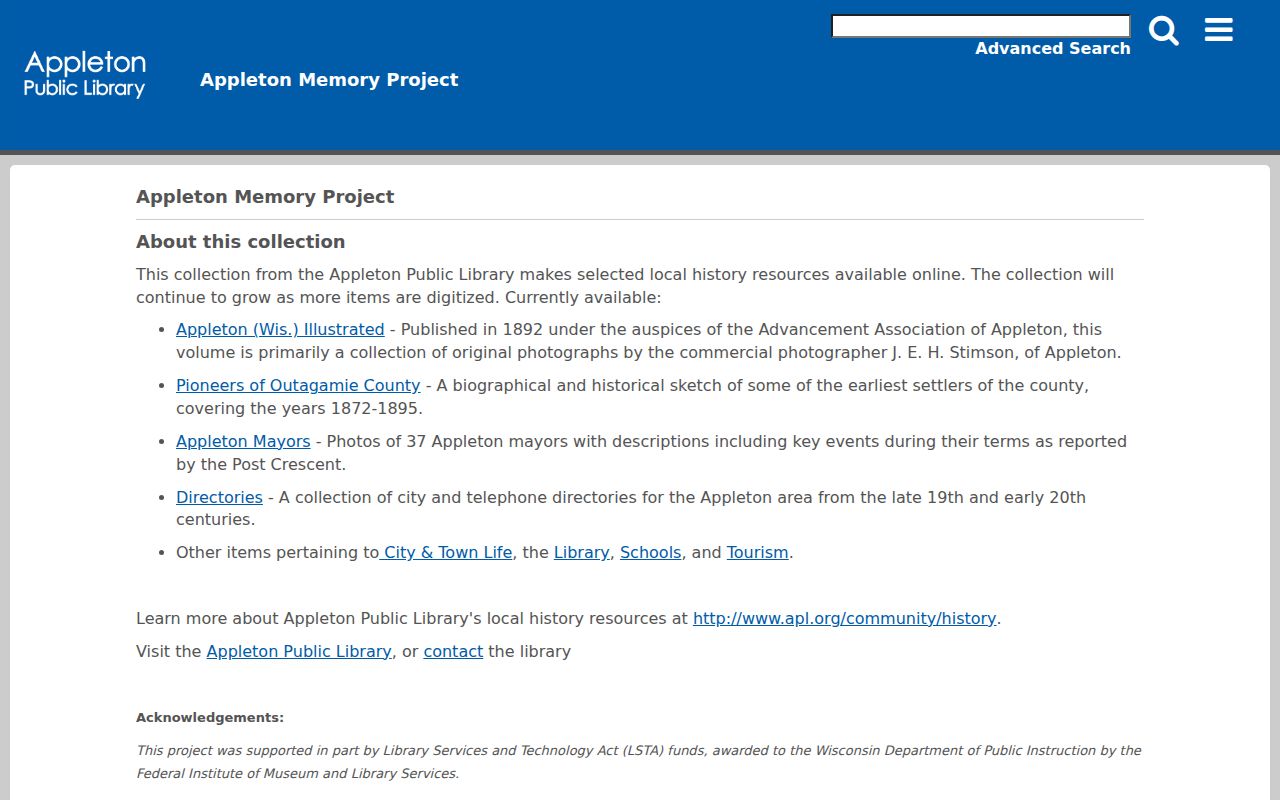
The interface finds possible pages, but the image holds the evidence.
Trace Family Through Appleton Directories
One city directory may list one adult while omitting children, kin, and boarders. Build a match across dates and sources.
- Copy the exact name, address, trade, firm, and shorthand.
- Search the next known edition by surname and initials, then use its street section.
- Pair the entry with a released census and compare ages and relationships.
- Check an obituary, newspaper, yearbook, veterans' record, or church register.
- Use a deed and legal description if the street number changed.
Most 1890 population schedules were lost. Fill that gap with Appleton directories, newspaper film, plats, church and cemetery sources, deeds, and surviving special schedules. Disappearance from a listing can mean a move or omission, not just death.
Appleton Library Directory Help
The Jabas Collection holds directories, yearbooks, plats, Sanborn maps, photos, and more than 1,500 newspaper microfilm rolls back to 1853. Readers are self-service. Scans may be emailed or saved to USB free, while printing costs money. The partial obituary index leads to film, and staff describe a free article-email service.
APL offers a free 45-minute Genealogy Jumpstart meeting in person or by Zoom, with a usual reply in three to five business days. The researcher page lists Monday through Thursday 9 to 8, Friday 9 to 6, Saturday 9 to 1, and Sunday closed. Check before travel because another page differs. Ancestry Library Edition is in-library only; HeritageQuest works remotely with a card.
Jabas Appleton Collection
200 N Appleton St
Appleton, WI 54911
920-832-6173
askus@apl.org
Extend Appleton Directory Evidence
A former classmate trail can combine yearbooks, directories, the obituary index, newspapers, and a school archive. Lawrence University collections may aid searches for former students, faculty, and campus groups, but no open alumni roster was verified. Ask by name and date.
Post-Crescent sources include more than 9,000 issues from 1860-1972 and online coverage from 1999 forward. Other licensed databases vary. No official city cemetery search was found, so use church cemeteries, veterans' grave registration, Wisconsin Historical Society sources, FamilySearch, and full obituaries. Each adds a separate check on a directory entry.
Appleton Records at the Museum
The History Museum at the Castle holds government, military, religious, club, family, map, photo, and directory materials. It reports more than 20,000 artifacts, 800 cubic feet of manuscripts, 2,000 volumes, 350 maps, and over one million photos. Researchers file a form and book at least one week ahead. Fees apply, and drop-ins are not offered.
The official collection entry point appears below.
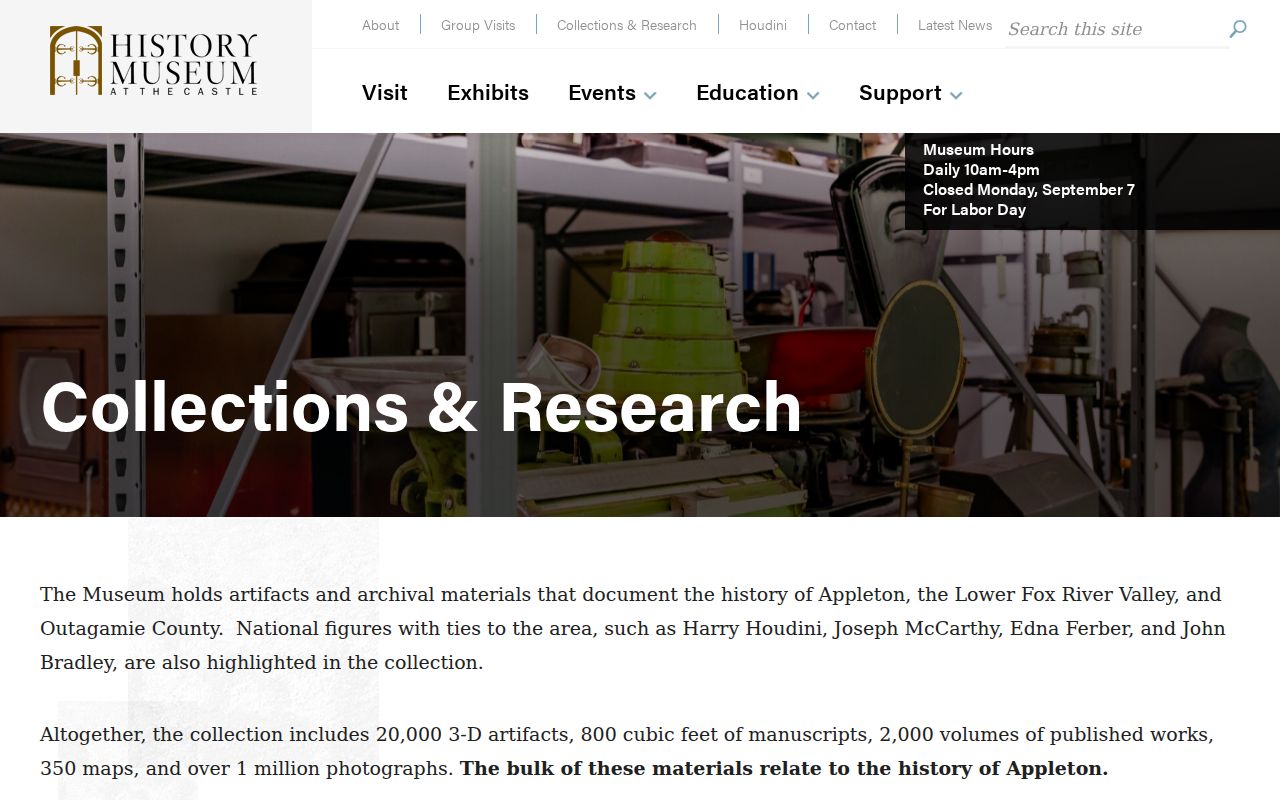
Museum records add visual and institutional context missing from a printed line.
Work Clues in Appleton Directories
Fox River paper firms, locks, woolen mills, Appleton Wire Works, rail links, schools, and churches can identify a person whose address is vague. Historic records name the College Avenue district, Fox River Paper district, Locks 1 through 4, J.B. Courtney Woolen Mills, City Park, and Lawrence Main Hall. A firm can separate people with the same initials.
Search company, church, cemetery, society, and labor sections as well as names. For modern parcel work after the historical trail, use the Appleton street directory. A work line remains a dated association, not proof of a whole household.
Limits of Appleton City Directories
A directory is selective. It may name a household head, subscriber, worker, or firm while omitting others. Printed Appleton usage may reach nearby towns. No last printed year, continuous shelf run, official renumbering year, or reverse-directory span was verified. Use plats, maps, nearby entries, and a parcel legal description to bridge change.
Keep gaps visible. Historical entries support genealogy, reunions, estate work, and local history, but never monitoring, threats, or harassment.
Begin with a free page image when one exists. If a year is absent, ask APL about the printed shelf, microfilm, obituary index, and research service. FamilySearch supplies a catalog route for nearby county places. The History Museum adds manuscripts, photos, clubs, firms, and government context. A deed or plat can then test the address itself.
Record the edition, year, page, spelling, and date viewed. Save both OCR and image citations. If two directories disagree, the difference may mark a move, print error, business address, or two similar names. Test it with another dated source.
Older county research can reach beyond Appleton and Outagamie. Outagamie County was detached from Brown County in 1851, and an early county record says H.S. Eggleston was paid to transcribe Outagamie references from Brown County books. For a person or property trail that begins before independent Outagamie records, check Brown County references and later transcriptions. This predecessor-county route can explain a missing early name more credibly than assuming the record was lost.
Naturalization, immigration, military, church, and parish material may also sit outside the city directory shelf. The research identifies Wisconsin Historical Society collections, FamilySearch, federal archival holdings, university collections, diocesan archives, and the History Museum as possible custodians. Exact Appleton church and naturalization index years were not verified. A useful request names the person, denomination or institution, and likely date rather than asking for an undefined search.